
Turning the End of the Season into Your Club’s Biggest Opportunity


At Dare to Care, much of the work we do is about mobilizing the caring majority. In almost every team or club, most people want a respectful and safe environment. They don’t support bullying, harassment, or unsafe practices. Yet many stay silent, not because they don’t care, but because speaking up can feel risky. Athletes worry about playing time, parents worry about their child being singled out, and coaches may fear conflict within the organization.
That’s why one of the most powerful first steps toward change is often a simple one: creating safe ways for people to speak up.
End-Of-Season Survey
Anonymous end-of-season surveys can provide that opportunity. They give athletes, parents, and coaches a space to share their honest experiences without fear of consequences. For some, it may be the first time they feel comfortable saying, “Something didn’t feel right,” or “Here’s how we could make this better.”
On our Sporting Change Podcast, we recently spoke with Jennifer Fraser Ph.D. Among the many insights she shared about the neuroscience of bullying and culture in sport, one idea stood out: the end of the season is one of the most powerful moments a club has to improve its culture.
Ironically, it’s also the moment when everyone is ready to check out. After a long season, coaches can be burnt out, parents are juggling the next activity, and board members often have that final date circled on their calendar the same way kids mark the last day of school.
But before everyone logs off, heads on vacation, and closes the chapter on the season, there is one last important step clubs should take:
Ask your members how the season really went.
At Dare to Care, we see a pattern happen far too often. A club believes they had a great season. There were no major incidents reported, no formal complaints, and everything seemed to run smoothly.
Then on the final day—sometimes literally the last practice or tournament—an athlete or family approaches leadership and shares something difficult. They talk about the bullying, the mistreatment, or the unhealthy culture they experienced all season long, and end with a sentence that’s heartbreaking for any organization to hear:
“This is our last day. We’re not coming back.”
Knowing they are leaving the club often gives people the courage to finally speak up. With the season over and nothing left to lose, they feel safe enough to tell the truth.
But it raises an important question for every sports organization:
What if every athlete and family felt that same safety to speak up—without having to quit the sport they love first?
Anonymous end-of-season surveys can make a powerful difference. They create a space where athletes, parents, coaches, and volunteers can share their real experiences honestly and safely.
And when clubs listen to that feedback, they gain something incredibly valuable: the chance to improve before the code of silence pushes another athlete or family out the door.
Why End-of-Season Surveys Matter
Research on sport safety shows that organizations that regularly collect feedback are better able to identify:
Patterns in injuries or unsafe environments
Whether athletes feel comfortable reporting concerns
Coaching culture and respect levels
Whether policies are actually being followed
If athletes and families feel like they have a voice
Perhaps most importantly, surveys help answer a crucial question:
Does the culture we think we have actually match the culture people experience?
What to Include in Your Survey
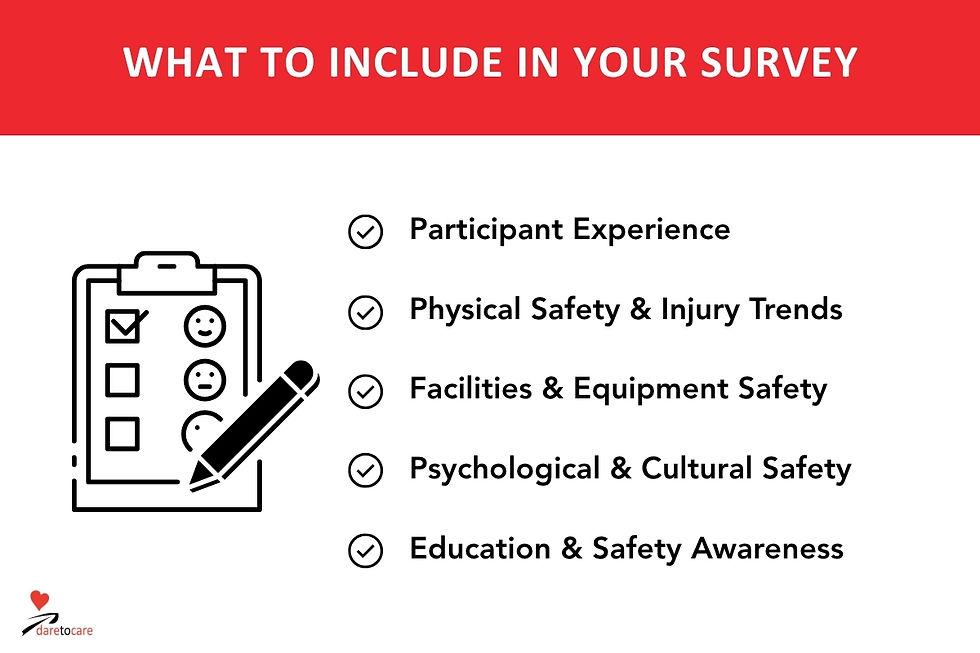
A strong end-of-season survey balances quantitative questions, like rating scales, with qualitative questions, such as open-ended responses. Ratings help clubs identify trends and patterns, while written answers provide the context needed to understand why those patterns exist.
Your survey should also include everyone involved—athletes, parents, coaches, volunteers, and officials—since each group experiences the culture in different ways. And while numbers show what is happening, stories explain why, giving clubs the insight they need to improve safety, respect, and culture for the next season. Here are the sections you should consider:
1. Participant Experience
Start by identifying who is responding. Different groups experience sport differently.
Example questions
What is your role? (Athlete, Parent, Coach, Volunteer)
What age group were you involved with this season?
How many seasons have you been involved with this club?
Why this matters
Different age groups and roles often reveal very different issues and segmenting responses allows clubs to identify where improvements are needed most.
At the same time, it’s important to strike the right balance.
You want enough information to spot patterns and potential problem areas, but not so many identifying details that people worry their responses could be traced back to them. If members believe their anonymity might be compromised, they are far less likely to be honest. The goal is simple: collect meaningful insights while ensuring people feel safe enough to tell the truth.
2. Physical Safety & Injury Trends
Athlete safety begins with understanding what injuries are happening and why.
Example questions
Did you sustain any injuries that caused you to stop playing?
Did any injury require medical attention (physio, doctor, ER)?
What was the primary cause of injury?
Were return-to-play or concussion protocols followed properly?
Why this matters
Tracking injury trends allows clubs to identify:
Risky drills or coaching practices
Poor equipment or facilities
Lack of proper injury protocols
It also reinforces that athlete health matters more than performance.
3. Facilities & Equipment Safety
Sometimes the biggest safety risks are environmental.
Example questions
Rate the following from 1–5 (Strongly Disagree to Strongly Agree):
Playing surfaces were well maintained and safe
Safety equipment was available and properly fitted
Practices and games were canceled when weather conditions were unsafe
Why this matters
Facility issues often go unreported during the season because athletes and parents assume someone else will deal with it. Surveys provide a way to surface these concerns.
4. Psychological & Cultural Safety
Whenever bullying or mistreatment occurs—whether physical, verbal, social, relational, or online—it always carries a psychological impact. The effects aren’t limited to the athlete directly involved; families can also feel the stress, worry, and emotional toll.
Psychological safety is the area most clubs will deal with on a day-to-day basis, and why it should be central to any end-of-season survey.
Example questions
Rate from 1–5 (Strongly Disagree to Strongly Agree):
I felt respected by my coaches
I felt a sense of belonging with my teammates
Coaches promoted a positive team culture
I felt safe raising concerns with staff or leadership
Bullying or disrespectful behavior was addressed appropriately
Open-ended question:
Did you witness or experience bullying, harassment, or emotional mistreatment this season?
Why this matters
Research consistently shows that athletes are far less likely to report misconduct if they fear retaliation or dismissal. Anonymous surveys can surface concerns that might otherwise remain hidden.
5. Education & Safety Awareness
Policies are only effective if people understand them.
Example questions
Did you receive education about X (i.e. concussion protocol, safeguarding, bullying, etc.) this year? Follow-up: what kind of education was most beneficial to you?
Do you understand the club’s code of conduct and reporting process?
Why this matters
Many clubs have excellent policies—but families and athletes don’t know they exist. This section helps determine whether your education efforts and your policies/procedures are actually reaching people.
You Have the Results… Now what?
Collecting feedback is only the first step. The real impact comes from what your club does next. The off-season is the perfect time to turn survey results into action. Here are three key steps.
1. Hold Internal Reviews
Bring together your staff, coaches and board members to review the survey data together and ask:
What patterns are emerging?
What surprised us?
Where are we falling short?
With safety and honesty, some team or staff members may share negative feedback. It is a privilege to receive commentary that is not sugar-coated or false. This is not a threat to be met with a defensive response or ego battle. This is an opportunity to provide necessary reconciliation and raise standards for next season.
2. Update Your Code of Conduct
Many organizations have a code of conduct—but it often sits on a website or in a registration package.
The off-season is the perfect time to:
Revise outdated policies
Clarify expectations around respect and safety
Strengthen reporting processes
Reach out to organizations to help you with policies and procedures.
But the real question is not “Do we have a code of conduct?”
It’s “How do we bring it to life? How do we take it off the page?”
3. Turn Policies Into Practice
A culture doesn’t change because a document changes. It changes because people learn, practice, and reinforce new behaviors.
That means:
Pre-season education for coaches
Athlete workshops on respect and reporting
Parent education about culture and safety
Programs like Dare to Care have a proven track record, for the last 27 years, of helping clubs turn policies into real conversations and real skills.
Culture Requires Renewal
One final reality often overlooked in sport: Club culture resets every year. Why? Because every season brings new athletes/parents, athletes aging into new divisions, new coaches/staff, and new board members.
Education and culture-building cannot be a one-time effort. They must be renewed every season.
The End of the Season Is the Beginning
For many clubs, the end of the season feels like a shutdown. But in reality, it’s the best opportunity for reflection and growth.
Run the survey.
Listen to the feedback.
Use the off-season to strengthen your culture.
If you’ve read this far, it shows that you care deeply about your team and want what’s best for your athletes. Sometimes it feels like everything is going smoothly—but that doesn’t always tell the full story. Individuals who engage in bullying or other harmful behaviors can be masterful at hiding what they do, and unhealthy dynamics can become normalized without anyone realizing it. That’s why it’s so important to create a space for your members to speak up, remove conflicts of interest, and act on the feedback you receive. When you do, you not only protect your athletes—you strengthen your entire club and ensure every child can thrive in life, learning, and play!


